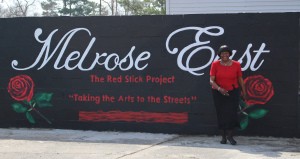
There is nothing about North Baton Rouge’s Titian Avenue that reflects the high-renaissance style of its namesake, Italian painter Tiziano Vecelli.
Rather than domed cathedrals and ornate arches, Titian is lined with dilapidated apartment complexes, duct-taped cars and boarded-up windows. At the end of the street sits an idle drug rehabilitation center.
The neighboring Monet Drive, and Van Gogh and Goya avenues comprise the rest of the “Mall City” neighborhood behind the old Bon Marche shopping center, an area now defined by intense violence and prolific drug use.
But in the middle, between the corner grocery and the rehab clinic, stands the Rev. Patricia Hatch of Hope and Healing Outreach Ministries – a woman fighting to save this area – a woman who said she always wanted to be different.
Born in 1960 not far from “Mall City,” Hatch was the youngest of six children.
Her father abandoned the family shortly after her birth. Her mother was an alcoholic who sold and used drugs and was in and out of jail throughout Hatch’s childhood.
“I didn’t want to be what my mother was,” she said. “ I wanted to be different.”
And she was.
As the “baby” of the family, Hatch said she was the only one of her siblings to not have been convicted of a crime and sent to jail while growing up.
But despite, or possibly in spite of, her respectable behavior, Hatch said she was never accepted at home. Her siblings and peers distanced themselves from her and often harassed her for not participating in drug-related activities.
“I was the black sheep of the family,” she said. “It was rough.”
But when Hatch was 17, she found a place where she didn’t feel so alone.
While walking down Plank Road near her home one evening, she came across a meeting outside the Bibleway United Pentecostal Church.
She was quickly drawn in by the church’s welcoming message and fellowship. Ten months later she was baptized by Pastor Abraham Washington and began to do “street ministry” with the church.
Each week Hatch and other leaders set up tents outside of Bibleway. They offered food and comfort to any passerby as the church had done for Hatch just months before.
As Hatch continued to serve others she said she grew “hungrier and hungrier for more.”
She continued to work with Bibleway for close to 30 years before opening her first church in the neighborhood, House of Hope, in 2003 with her then-husband Leroy Hatch.
She began Hope and Healing Ministries five years later where she functions as the sole pastor and proprietor, running her church “paycheck-to-paycheck.”
In the same way she was welcomed into the church community, Hatch brings her message of love and support along with free food and donated clothes to the street, where she thinks people need help most.
“I put Hope and Healing in this neighborhood because I wanted to be right in the mix of it,” Hatch said. “If they won’t come to us, we take the ministry outside.”
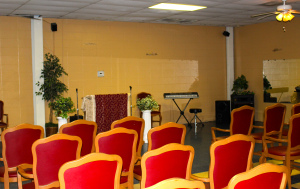
She said she realizes that many visitors come simply to take advantage of the hospitality and disregard her Christian message, saying she once witnessed a visitor take a donated pair of shoes, sell them and use the money to buy drugs down the street.
But she said that despite this exploitation and what she describes as her daily exposure to abuse, violence and drugs, she has maintained her desire to serve her community while discounting her personal needs.
“As long as I have God in my life, I don’t have to worry about my problems,” she said. “I just have to worry about His [problems] and how I can help others.”
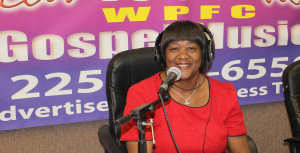
Since the opening of her new church and the recent installment of her local radio talk show on WPFC, Hatch said she has bought hotel rooms for the homeless, paid rent for members of her congregation, talked men and women away from suicide and murder plots, and has even brought teenagers out of the drug scene.
“You just have to show them love,” she said.
Romalis Clennon, 16, is one congregation member who has benefited this love first hand.
According to Hatch, Clennon’s family was stranded in New Orleans during the traumatizing floods that struck the city following Hurricane Katrina. She said the family was “haunted” by their experiences for years after the storm.
Clennon admitted that he turned to drugs as a young teen.
But last July, he, his 12-year-old sister Chara and mother, Dona, began attending Hope and Healing, located blocks away from their apartment.
He and his sister said the church took them in as family, and they now view Hatch as a “second grandmother.”
Clennon said that today he no longer uses drugs. An avid videogame player, he hopes to attend the ITT Technical Institute to become a game designer after high school.
Though Clennon said he is happier today, he still faces many of the same challenges as other residents of “Mall City.”
In early March, he was awakened by two shots fired through the window of his apartment. He also noted that his high school classmates show little desire to become involved in a church community as he has.
Hatch acknowledged that there is still a great deal of work to be done in the neighborhood, and she still sees and hears of negative experiences like Clennon’s on a daily basis.
According to the FBI’s annual crime report, Louisiana has the highest murder rate in the country, with the majority of crimes taking place in larger cities.
The most recent report found that in 2012 there were 10.8 murders and non-negligent manslaughters per 100,000 people.
Of the 495 charges, 450 took place in a metropolitan area, like Baton Rouge.
In addition to these statewide statistics, the Baton Rouge Police Department’s most recent crime report showed that in 2012 there were 67 homicides and 1,343 aggravated assaults in the city.
Hatch said that she has noticed that crime has escalated over years, but she believes that engaged churches like hers provide the best solution to the problem.
“The church is going to fight naturally and spiritually,” she said. “ I think the church can be a great success if they go out there and do it.”
Though the statistics aren’t in her favor, Hatch said she will continue her work to bring hope and fellowship to one of Baton Rouge’s bleakest communities.
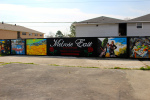
And starting last month, the area Hatch knows so well has enjoyed a new hue, as a mural has been erected depicting the work of the street’s eponymous artists.
Hatch recognizes that there is no “quick fix.” However, with this new pop of color in addition to the perpetual light she brings to a dark place, she said she has faith that things can be different in “Mall City.”
More Photos of the Melrose East art wall:

Web Extra: Interactive Map of Mall City
 Laura Furr Mericas